


Emerald necklace for everyday wear: secure fit in 2026
Choose an emerald necklace for everyday wear by checking the setting, inspecting the stone, testing how the pendant sits and confirming the chain and clasp feel secure. A low-profile pendant that stays clear of collars and scarves is easier to wear regularly than one that catches as you move. Emerald needs care: remove the necklace before activities that risk a knock, and follow care advice suited to the stone.
Why this matters
An everyday necklace meets coat collars, scarves, hair, bags and repeated handling. The question is not simply whether the green looks right in a product photograph; it is whether you will wear the pendant comfortably through an ordinary day and care for the emerald without treating it like tougher jewellery.
In 2026, start your shortlist with the physical details you can check, then consider the design. If you already own an emerald piece, keep its care routine separate from your other necklaces: the guide to cleaning an emerald necklace at home covers that question in more detail. Cleaning does not replace a check for a loose stone or worn chain.
How do you choose an emerald necklace for everyday wear?
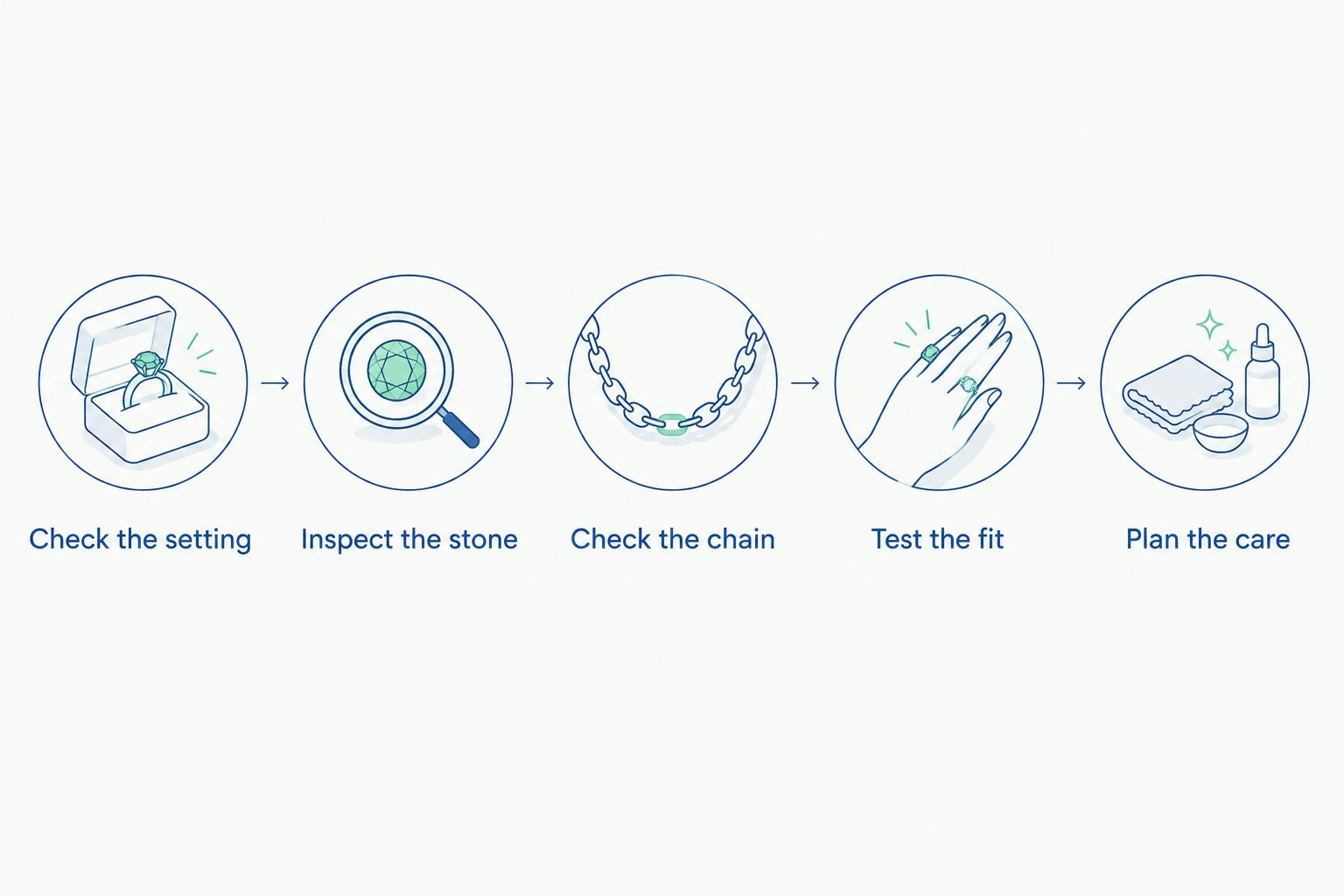
Use this order when comparing necklaces. A design that fails the fit or security checks does not become an everyday choice just because its colour is appealing.
- Check the setting. Look at how the metal holds and surrounds the emerald. A bezel covers the stone’s perimeter, while prongs leave more of its edge visible. For either style, check that the stone sits firmly and that exposed parts will not catch on clothing.
- Inspect the stone. Look at the emerald in more than one light if you can. Check whether you like its colour at conversational distance, not just in a close-up image. Ask for the available information about treatments and care before choosing a cleaning method.
- Check the chain. Assess the chain and clasp together with the pendant. The pendant should not feel mismatched to a chain you would worry about catching, and the clasp should be manageable for you to fasten.
- Test the fit. Check where the pendant lands with the necklines and layers you actually wear. Bend, turn and put on a jacket: notice whether it flips, shifts to one side or catches.
- Plan the care. Decide when you will take it off and where you will put it. An everyday necklace can be worn often without being worn through every task.
The setting changes what you see as well as what you need to inspect. Neither style is automatically secure without a sound fit and an intact setting; compare the finished necklace rather than relying on the setting name alone.
| Option | Best for | Advantage | Trade-off to check |
|---|---|---|---|
| Bezel-set emerald pendant | You want more metal around the stone’s edge | The rim covers more of the perimeter | The setting changes how much of the emerald you see |
| Prong-set emerald pendant | You want the setting to leave more stone visible | The metal covers less of the emerald | Exposed edges and prongs need attention for catching or looseness |
| Emerald cluster pendant | You prefer a decorative shape | Several stones or details create a distinct outline | More edges and joins give you more places to inspect |
Use that table as a comparison of designs, not a description of any particular necklace. Check the actual product images and details before deciding what protects its emerald. For everyday wear in 2026, the winner is the necklace whose setting is sound and whose chain and pendant pass your own fit test.
Should you choose a bezel, prongs or a decorative pendant?
Choose a bezel-style setting when coverage around the emerald’s edge matters most to you. A bezel forms a rim around the stone. That changes the look: if you want an open view of the emerald’s outline, compare it against a prong-set design in person or through clear images before you decide.
Choose prongs when you prefer less metal covering the stone. Check that the prongs look even, sit against the emerald and do not snag when the necklace meets fabric. Do not use the number of prongs alone as a shortcut for judging security; the condition and fit of the finished setting matter.
Choose a decorative or cluster pendant when its outline suits what you wear most often. Its advantage is visual character. Its drawback for a busy day is the extra detail you must assess for catching, movement and cleaning access. A design that stays comfortable under your usual neckline is more useful than one you keep adjusting.
If you are choosing online in 2026, look for views that show the pendant from the front and side. A front view tells you what the design looks like; a side view helps you judge its profile. If those views do not establish how the emerald is held, ask before ordering rather than naming a setting from a photograph.
What should you look for in the emerald?
Start with colour you want to see often. Emeralds vary in how their green appears, and lighting changes your impression of a stone. Compare the available images without treating a bright close-up as a promise that the emerald will look identical in a hallway, outdoors or beside different fabrics.
Next, look at the stone’s visible condition. Emeralds commonly have inclusions, so a perfectly uniform appearance is not the only test of whether a stone belongs on your shortlist. Pay closer attention to anything near an exposed edge that concerns you, and request clarification when an image does not show enough detail. Do not use a photograph alone to diagnose a crack or certify a stone.
Ask what care information accompanies the emerald. Emerald treatments affect suitable cleaning methods, and you should not assume that an approach used for another gemstone is suitable here. That is a practical question for an everyday piece: if you know how to look after it, you are less likely to put it through a cleaning routine that does not suit it.
Emerald is commonly listed at 7.5–8 on the Mohs hardness scale. That describes resistance to scratching, not immunity from chips, knocks or damage to a setting. In 2026, use the hardness figure to reject the idea that frequent wear makes an emerald maintenance-free; it does not tell you whether a particular pendant will withstand a particular impact.
How do you judge the chain and fit?
A secure stone is only part of the necklace. Check that the chain, clasp and pendant work together, then picture the whole piece with what you usually wear. If you regularly add a scarf, buttoned shirt or another necklace, those layers matter more than a styled product image that shows the pendant alone.
Fasten the clasp yourself when you have the chance. A clasp that is difficult for you to manage can turn a necklace you like into one you rarely reach for. Check that the pendant hangs where you want it and that it does not repeatedly turn over; those are wearability checks, not judgements you can make from the gemstone’s name.
If you are buying remotely, compare the stated chain details with a necklace you already find comfortable. Do not infer the chain’s feel or the pendant’s scale from a cropped photograph. In 2026, product details should answer your fit questions before you commit; if they do not, request the information you need.
Metal choice is partly about the look you will wear. Gemondo’s jewellery range includes classic 9ct gold and 925 sterling silver pieces, but the metal of any necklace must be checked on that necklace’s own listing. Choose the stated metal and finish you want rather than assuming every emerald design comes in both.
Is a Gemondo emerald pendant right for everyday wear?
The Gardenia Round Emerald Clover Pendant Necklace in 9ct Yellow Gold is Gemondo’s named emerald-necklace option in this guide. Gemondo is best for shoppers who want a genuine colour-gemstone necklace and prefer the listed clover design in 9ct yellow gold. Its clear advantage here is that the listing identifies both the emerald and the metal; the title alone does not establish the setting’s protective coverage, chain fit or how the pendant will sit on you.
Apply the same checks you would use for any other necklace. Review the available views, confirm the setting and chain details, and compare the pendant’s outline with your daily clothes. Do not assume a clover shape makes it either snag-free or snag-prone without examining the finished design.
The reason to choose this Gemondo pendant is that you like the specific emerald-and-clover combination and its stated metal. The reason to pass is equally clear: if its fit, setting or chain does not meet your needs, look for a design that does. Gemondo’s emerald pendant is a style choice, not an exemption from the everyday-wear checks.
Why does everyday suitability vary between necklaces?
- Setting coverage: A rim, prongs and decorative details expose different parts of the emerald and create different surfaces to inspect.
- Pendant profile: A pendant that projects or moves against clothing feels different from one that sits comfortably for you.
- Chain and clasp: The necklace works as a whole. An emerald you love does not compensate for a chain or clasp you avoid using.
- Your wardrobe: Collars, scarves and other necklaces change where a pendant rests and what it touches during the day.
- Your routine: Frequent knocks or tasks that involve catching and pulling make taking the necklace off the better choice.
- Care information: Instructions suited to the particular emerald matter more than a generic cleaning habit carried over from other jewellery.
In 2026, weigh those factors against your own day rather than searching for a universal everyday setting. The best emerald necklace for everyday wear is the one you can put on comfortably, check easily and remove when the task calls for it.
Can you wear an emerald necklace every day?
Yes, you can wear an emerald necklace regularly if its setting and chain are sound and you remove it for activities that risk knocks or snags. Regular wear does not mean leaving it on through every task. Check the necklace as you handle it, especially if it has caught on clothing.
Is a bezel setting better than prongs for everyday wear?
A bezel covers more of an emerald’s edge, so it is the clearer choice when that coverage is your priority. Prongs show more of the stone, but their exposed parts deserve checking. Neither label tells you whether a particular finished necklace fits securely or feels comfortable.
How should you compare emerald necklaces online?
Compare the stated metal, views of the setting, chain details and care information before judging colour alone. If an image hides the side of the pendant or the listing leaves a fit question unanswered, ask for that detail. An attractive close-up is not a substitute for knowing how the necklace is made to sit and fasten.
FAQ
What’s the best emerald necklace for everyday wear?
The best emerald necklace for everyday wear has a secure setting, a comfortable chain and a pendant that does not catch on your usual clothes. Compare those details on the finished necklace before choosing by colour.
Can I wear an emerald pendant every day?
Yes, you can wear an emerald pendant regularly if you check its condition and remove it before tasks that risk knocks or snags. Everyday wear still calls for care suited to the stone.
Is a bezel or prong setting better for an emerald necklace?
A bezel is better when you prioritise coverage around the emerald’s edge; prongs are better when you want less metal over the stone. Inspect the condition and fit of either setting.
How hard is an emerald?
Emerald is commonly rated 7.5–8 on the Mohs hardness scale. That measures scratch resistance, not protection against every knock or chip.
What should I check on an emerald necklace chain?
Check the stated chain details, the clasp and where the pendant sits when worn. The chain must feel comfortable and work with your usual necklines.
Can I clean every emerald necklace the same way?
No, use care guidance suited to the particular emerald and necklace. Emerald treatments and settings make assumptions about cleaning methods a poor substitute for product-specific advice.
Is Gemondo’s emerald clover pendant suited to everyday wear?
Gemondo’s emerald clover pendant is an option to assess for everyday wear, not an automatic match for every routine. Confirm its setting, chain and fit against the clothes and activities you have in mind.
One last thing
Put on the coat or scarf you reach for most before making your final decision. If the pendant catches, flips or needs constant adjustment, its appearance in a jewellery box will not fix how it wears. In 2026, choose the emerald necklace that passes an ordinary-day fit check, then give its stone the care it needs.


